Doctoral Thesis Defense in “Computer Science” by Mr. Abubakar WAKILI
Doctoral Thesis Defense in “Computer Science” by Mr. Abubakar WAKILI
The Euromed University of Fes (UEMF) is pleased to inform the public of the Doctoral Thesis Defense in “Computer Science” by Mr. Abubakar WAKILI.
The thesis defense will take place on June 6, 2026 at 9:00 AM at UEMF.
- Presented by: Mr. Abubakar WAKILI
- Location: The Great Hall of the Incubator (LOC001994)
- Topic: A Study and Conception of an Optimized and Secured Routing Protocol for IoT Platforms Using an Artificial Intelligence Algorithm
Summary
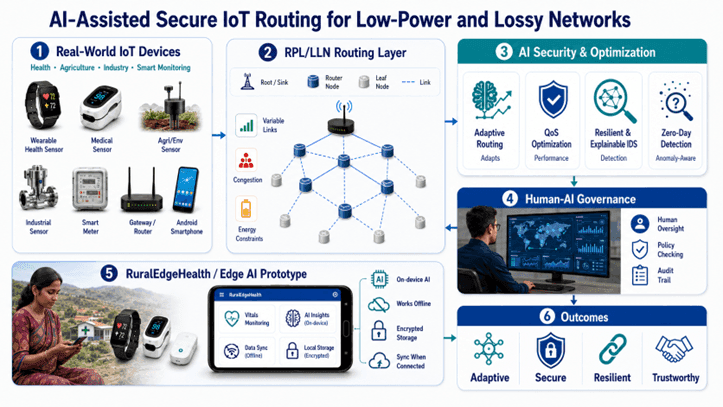
Modern Internet of Things (IoT) systems rely on networks of constrained sensing and computing devices that operate with limited energy, processing power, and communication capacity. In these environments, routing is essential because it determines whether data collected by sensors reaches applications reliably, securely, and on time. The Routing Protocol for Low-Power and Lossy Networks (RPL) is widely used in such systems, but its static routing mechanisms adapt poorly to changing network conditions and remain vulnerable to routing-layer attacks. This thesis investigates how artificial intelligence can improve the optimization and security of IoT routing systems. It follows a system-engineering and Design Science Research methodology, combining RPL experimentation, simulation-based evaluation, machine learning, intrusion detection, explainability, zero-day threat detection, and human-AI governance. The research develops several connected contributions. The Adaptive Objective Function (AOF) improves RPL routing by dynamically selecting and switching routing objective functions according to network conditions and application requirements. The NANTAR framework introduces AI-assisted monitoring and mitigation of routing-layer attacks. A machine learning-based QoS and security framework combines traffic classification and adaptive decision-making to improve routing performance and protection. The thesis also proposes a resilient and explainable intrusion detection system, the ZeroDefense framework for unknown attack detection, and the HITL-IoT framework for human oversight and auditable AI-assisted cybersecurity decisions. In addition, the RuralEdgeHealth prototype demonstrates practical offline mobile Edge AI on entry-level Android smartphones using lightweight models, local inference, and encrypted storage. Overall, the thesis contributes to adaptive, secure, resilient, and trustworthy IoT routing through carefully designed AI-assisted mechanisms.
This thesis will be presented to the jury members
| Full Name | Grade | Institution | Quality |
|---|---|---|---|
| Prof. Abdelghafour Marfak | Full Professor | Euromed University of Fez | Jury Chair |
| Prof. Said Najah | Full Professor | Sidi Mohamed Ben Abdellah University, Fez | Reviewer |
| Prof. Mohammed Airaj | Full Professor | Sidi Mohamed Ben Abdellah University, Fez | Reviewer |
| Prof. Taha Ait Tchakoucht | Associate Professor | Euromed University of Fez | Reviewer |
| Prof. Abdellatif El Abderrahmani | Full Professor | Sidi Mohamed Ben Abdellah University, Fez | Examiner |
| Prof. Mohammed Ouanan | Full Professor | Moulay Ismail University, Meknes | Examiner |
| Prof. Ahmed El Hilali Alaoui | Full Professor | Euromed University of Fez | Thesis Director |
| Prof. Sara Bakkali | Assistant Professor | Euromed University of Fez | Thesis Co-Director |