Doctoral Thesis Defense in Social Sciences by Mr. Ouassim BENSOUDA KORACHI
Doctoral Thesis Defense in Social Sciences by Mr. Ouassim BENSOUDA KORACHI
The Université Euromed de Fès (UEMF) is pleased to inform the public of the
public defense of a doctoral thesis in Social Sciences
The thesis defense will take place on Monday, October 14, 2024 at 1:00 PM at UEMF
Location: the Main Hall of the Incubator (LOC001994)
The thesis will be presented by Mr. Ouassim
BENSOUDA KORACHI on the theme:
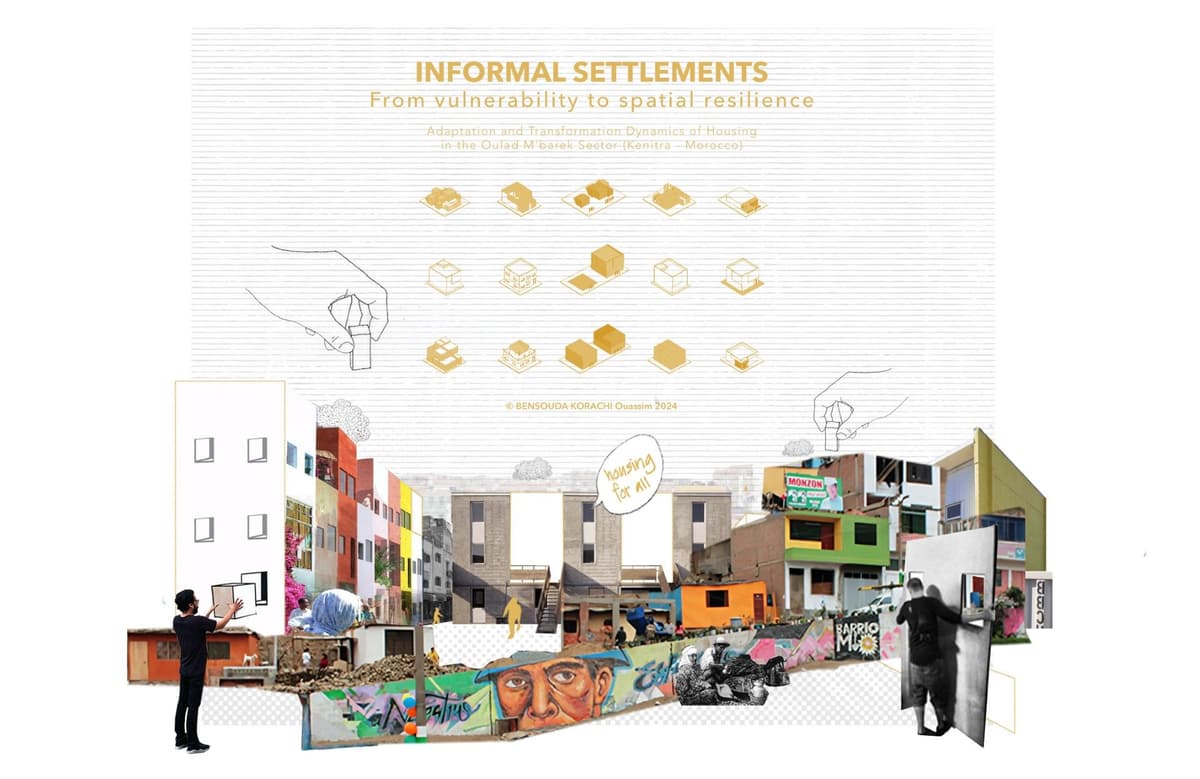
“INFORMAL SETTLEMENT: FROM VULNERABILITY TO SPATIAL RESILIENCE Adaptation and Transformation Dynamics of Housing in the Oula Mbarek Sector”
Abstract
Informal settlement, a worldwide phenomenon linked to rapid urban growth and a shortage of affordable housing, is often seen either as an expression of socio-economic vulnerability or as a manifestation of resilience (economic, social, spatial, etc.).
In Morocco, various programs have been undertaken to address this phenomenon. The most recent of these, the “Cities Without Slums” program, has tackled the problem of informal settlement through three different operational modes: rehousing, restructuring, and resettlement.
Although widely adopted, resettlement has encountered a number of challenges, leading to a phenomenon of re-informalization, characterized by the reproduction of spatial practices specific to informal settlements. This phenomenon is particularly evident in the Oulad M'barek sector, the focus of our study.
In the context of this thesis, we postulate that while the phenomenon of re-informalization highlights the limitations of the adopted operational mode, it also reveals the resilience of the vulnerable populations concerned by the program. A better understanding of this phenomenon could therefore lead to the development of more appropriate programs.
Our thesis therefore set out to identify the spatial characteristics that confer informal settlement its capacity for resilience, to analyze the processes by which they are reappropriated in resettlement sites, and finally to draw up recommendations for improving housing production methods in resettlement programs.
To this end, four indicators of spatial resilience specific to informal settlement were developed: self-organization, connectivity, diversity, and flexibility. These indicators represent the spatial attributes that promote the consolidation and integration of new spatial components within informal settlements.
Through these indicators, a theoretical framework was developed. This framework, made up of behavioral, integrated, and emergent sub-indicators, was applied in the case study carried out in the Oulad M'barek sector in Kénitra (Morocco).
The data, collected using transects, focus groups, structured surveys, and architectural surveys, were subjected to a thematic analysis.
The results of the Oulad M'barek case study confirmed the persistence of resilient informal practices despite the interventions carried out as part of the resettlement program. Spatial resilience, characterized by the adaptation, transformation, and expansion of the informal fabric studied prior to its demolition, was transposed and reappropriated in the new resettlement sites.
This has led to the emergence of hybrid housing production mechanisms, located at the confluence of the formal and informal domains. These mechanisms enable resettled populations to adapt housing development to their specific constraints
The results of our research led to the creation of a practical guide addressed to local actors, including recommendations derived from the analysis of spatial resilience observed in the study area. The guide supports a holistic and inclusive approach, recommending a dynamic and adaptive vision of resettlement programs.
Keywords:
Informal settlement, Resettlement, Vulnerability, Resilience, Spatial resilience, Design guide
Summary:
Informal settlement, a worldwide phenomenon linked to rapid urban growth and a shortage of affordable housing, is often perceived either as an expression of socio-economic vulnerability or as a manifestation of resilience (economic, social, spatial, etc.).
In Morocco, various programs have been undertaken to address this phenomenon. The most recent, the "Cities Without Slums" program, has tackled the resolution of informal settlement through three operational modes: rehousing, restructuring, and resettlement.
Resettlement, although widely adopted, has encountered several difficulties, leading to a phenomenon of re-informalization, characterized by the reproduction of spatial practices specific to informal settlement. This phenomenon is particularly marked in the Oulad M'barek sector, the subject of our study.
In the context of this thesis work, we postulate that while the phenomenon of re-informalization highlights the limitations of the adopted operational mode, it also reveals the resilience of the vulnerable populations concerned by the program. A better understanding of this phenomenon could therefore foster the development of more appropriate programs.
Our thesis thus undertook to identify the spatial characteristics that confer informal settlement its capacity for resilience, to analyze the processes of their reappropriation in resettlement sites, and finally to draw recommendations to improve housing production methods within resettlement programs.
To this end, four indicators of spatial resilience specific to informal settlement were developed: self-organization, connectivity, diversity, and flexibility. These indicators represent the spatial attributes that promote the consolidation and integration of new spatial components within informal settlement.
Through these indicators, a theoretical framework was developed. This framework, consisting of behavioral, integrated, and emergent sub-indicators, was applied in the case study conducted in the Oulad M'barek sector in Kénitra (Morocco).
The data, collected through transects, focus groups, structured surveys, and architectural surveys, were subjected to a thematic analysis.
The results of the Oulad M'barek case study confirmed the persistence of resilient informal practices despite the interventions carried out as part of the resettlement program. Spatial resilience, characterized by the adaptation, transformation, and expansion of the informal fabric studied prior to its demolition, was transposed and reappropriated in the new resettlement sites.
This has led to the emergence of hybrid housing production mechanisms, located at the confluence of the formal and informal domains. These mechanisms enable resettled populations to adapt housing development to their specific constraints.
The results of our research led to the design of a practical guide intended for local actors, containing recommendations derived from the analysis of spatial resilience observed in the study area. This guide supports a holistic and inclusive approach, recommending a dynamic and adaptive vision of resettlement programs.
Keywords:
Informal settlement, Resettlement, Vulnerability, Resilience, Spatial resilience, design guide.
This thesis will be presented before the jury members:
| Last and First Name | Institution | Role |
|---|---|---|
| Pr. Abderrahman TENKOUL | FSHS-UEMF | President |
| Pr. Majid MANSOUR | ENAR | Reviewer |
| Pr. Etienne GODIMUS | FAU-UMONS | Reviewer |
| Pr. Laurent DEBAILLEUX | FPMS-UMONS | Reviewer |
| Pr. Abderrahmane HADDAD | ISJP-UEMF | Examiner |
| Pr. Isabelle DE SMET | FAU-UMONS | Examiner |
| Pr. Iman Meriem BENKIRANE | EMADU-UEMF | Thesis Supervisor |
| Pr. Vincent BECUE | FAU-UMONS | Thesis Supervisor |
| Pr. Jérémy CENCI | FAU-UMONS | Co-Supervisor |
| Pr. Sanae KASMI | ISJP-UEMF | Guest |
| Pr. Abdelhadi IBNYAHYA | ENAR | Guest |
![[Call for Applications] Mobility at](/_next/image?url=https%3A%2F%2Fbackend.ueuromed.org%2Fuploads%2FSite_Mobilite_99ff41c88b.png&w=3840&q=75)
![[Call for Applications] Mobility at the EPF School of Engineering](/_next/image?url=https%3A%2F%2Fbackend.ueuromed.org%2Fuploads%2FSite_Mobilite_1_e5de226c65.png&w=3840&q=75)