[Quote of the Day] The Positive Thinker
[Quote of the Day] The Positive Thinker
By Professor Othmane Benmoussa
Vice‑President Research‑Innovation and Partnerships
Dean of the Euromed Polytechnique School
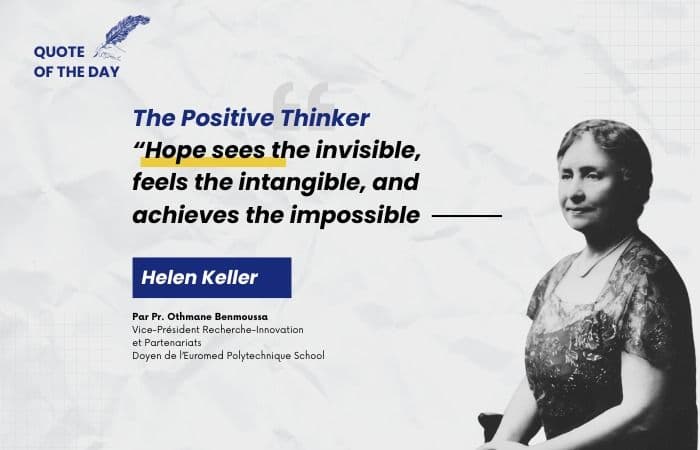
The Positive Thinker
“Hope sees the invisible, feels the intangible, and achieves the impossible.”
Helen Keller
In my view, this quotation has a particularly special character in the university field and, more generally, in this troubled period humanity is going through.
Helen Keller is an American author and speaker (12 books and numerous articles to her credit), the first person with a disability (deaf-blind since the age of two) to obtain a university degree, namely from Harvard in 1904.
It is accepted that “the first step toward the path to success is to try”, but we never truly experiment unless we hope, have a positive attitude and believe that we can achieve it.
If we start something without assuming from the outset that we will succeed, then we are not truly trying. This recalls the attitude of addicts who cannot end their dependence because, in reality, they never really believed they could.
When it comes to trying, we speak of truly trying by believing that, if we do our best, we have a chance to succeed. Success is certainly not guaranteed, but if one does not believe one will succeed, then failure is inevitable.
How then to remain positive and keep the right attitude ?
This is part of the character of the self-righteous. Moreover, if, with quick wins, we experience periods of success, self-confidence will improve and generate a highly constructive chain reaction.
As members of management, heads of institutions, deans, directors, staff and students, we must have and cultivate the "positive attitude." Indeed, if we do not believe that we will succeed, why should others follow us?
C’est le propre des authentiques leaders, des « transformational leaders »!
We absolutely must have confidence in ourselves, in our team and in our surroundings to inspire them and increase their confidence.
One of the most decisive actions in our professional journeys is to support one’s team and deploy all means to improve each of our habituses (according to Pierre Bourdieu) and sometimes to deploy significant effort and increased energy to help team members who initially brought negativity, perhaps generated doubt and consciously or unconsciously undermined others’ confidence, to metamorphose, then in turn help their colleagues and followers to transform.
This does not mean that we do not allow people to raise problems or highlight risks. On the contrary, we should welcome it because it could help us avoid obstacles and overcome the barriers that prevent us from succeeding.
Nevertheless, people who only see problems, constantly complain and systematically doubt the course of action (often without solid reasons) deserve to be supported so that we can collectively multiply our chances of success.
Ultimately, without appealing to theology and/or philosophy through thinkers like René Descartes in The Passions of the Soul or Ernst Bloch, at the opposite end from psychoanalysis, in The Principle of Hope (which calls on utopia and anticipatory consciousness), popular wisdom regularly uses proverbs like "hope keeps one alive."
In the manner of Helen Keller and many sages, let us therefore have hope, be positive, help one another and together build a bright future.