Soutenance de Thèse de Doctorat en "Governance and Developement" par Mme. Adjoba Audrey Paule N’ZE
Soutenance de Thèse de Doctorat en "Governance and Developement" par Mme. Adjoba Audrey Paule N’ZE
The Euromed University of Fes (UEMF) is pleased to inform the public of
the doctoral thesis defense in ” Governance and Developement ”
The thesis defense will take place on September 24, 2025 at 09:00 a.m. at l’UEMF
Location: Gallery, Building 1
The thesis will be presented by Ms. Adjoba Audrey Paule N’ZE
under the topic :
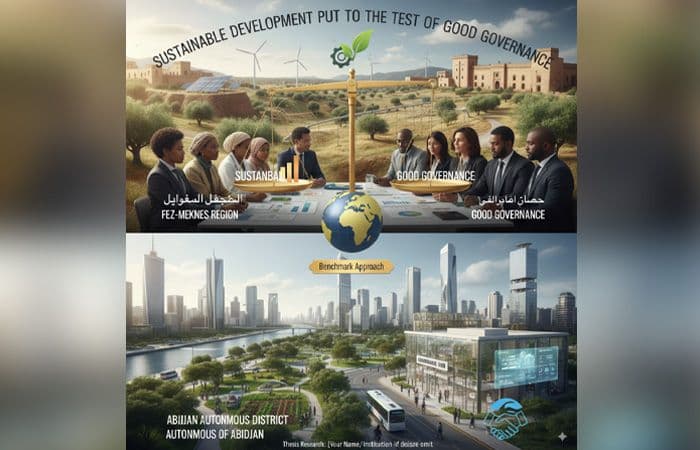
“ SUSTAINABLE DEVELOPMENT PUT TO THE TEST OF GOOD GOVERNANCE: Benchmark approach for the Fez-Meknes region and the autonomous district of Abidjan ”
General Summary
This thesis analyses the institutional factors that influence the trajectories of territories in terms of sustainable development. While the international community has adopted an ambitious normative framework with the SDGs, their concrete implementation reveals significant divergences, including within the African continent. This research examines the reasons for these divergences, positing the hypothesis that the effectiveness of sustainable development policies depends less on the adoption of universal standards than on the coherence and nature of local governance frameworks. First, the foundations of sustainable development, its main conceptual benchmarks and its intrinsic link to the notion of governance are explained through an in-depth review of the literature and an exhaustive bibliometric study. Next, a critical analysis of scientific research is proposed in order to highlight the evolution of the field, moving from a normative vision to a growing need to study the institutional factors that explain the performance of territories.
Three sets of factors, recognised but little explored in comparative analyses in the African context, are examined: i) the influence of national institutional architectures; ii) the role of multi-stakeholder governance mechanisms (negotiation, participation); and iii) the relevance of a multi-scalar methodological approach to overcome the limitations of traditional assessments.
The research approach adopted is therefore divided into three analytical parts. The first part establishes a macro-institutional theoretical framework based on regulation theory. It proposes a model for understanding how the “complementarity” of institutions (legal framework, professional organisations, financing networks) creates “historical dependencies” that shape governance models. This part justifies the relevance of a comparative analysis to reveal these underlying logics.
The second part is an empirical application of this framework through contrasting case studies from the Fez-Meknes region (Morocco) and the autonomous district of Abidjan (Côte d'Ivoire). It first describes and compares the characteristics and challenges of each territory, then analyses their respective governance systems in depth. For Fez-Meknes, the analysis focuses on the dynamics of contractualisation between the state and the region and on the construction of an SDG scorecard that reveals significant intra-regional disparities. For Abidjan, it focuses on metropolitan planning processes (SDUGA) and the management of structuring projects. This analysis highlights how distinct institutional frameworks translate into radically different governance processes, financing methods and intervention logics.
distinct institutional frameworks translate into radically different governance processes, financing methods and intervention logics.
Finally, the third part deepens this analysis through a critical benchmarking of projects and practices within the two territories. It goes beyond a simple comparison of results to propose a multidimensional qualitative analysis grid. This tool allows for a detailed assessment of convergences and divergences not only in terms of sustainability objectives (economic, social, environmental), but also in terms of processes (participation, coordination, conflict management). It thus demonstrates that the methodological choices and conceptual frameworks used for planning (SRAT vs SDUGA) explain only part of the trajectories observed. The results highlight that despite a certain homogenisation of the discourse on sustainable development, practices remain strongly rooted in institutional logic and local power relations. The dynamics of interaction between actors prove to be a more powerful explanatory factor than simple compliance with master plans.
This thesis will be presented to the jury members:
| Full name | Grade | Institution | Quality |
|---|---|---|---|
| Prof. AZZOUZI Abdelhak | Full Professor | Sidi Mohamed Ben Abdellah University, Fes | Jury Chair |
| Prof. NAGGAZ Zoubida | Full Professor | Sidi Mohamed Ben Abdellah University, Fes | Reviewer |
| Prof. OUAZZANI Ahmed | Full Professor | Ibn Tofaïl University, Kenitra | Reviewer |
| Prof. ROMLI Abdellah | Full Professor | Ibn Tofaïl University, Kenitra | Reviewer |
| Prof. BISSANI Athmane | Full Professor | Sidi Mohamed Ben Abdellah University, Fes | Examiner |
| Prof. RIZK Khalid | Full Professor | Ibn Tofaïl University, Kenitra | Examiner |
| Prof. TENKOUL Abderrahman | Full Professor | Euromed University of Fes | Thesis Director |
![[Appel à candidatures] Programme de double diplôme à l'École d'ingénieurs EPF](/_next/image?url=https%3A%2F%2Fbackend.ueuromed.org%2Fuploads%2FSite_Mobilite_14f1887666.png&w=3840&q=75)
![[Appel à candidatures] Mobilité à l'École d'ingénieurs EPF](/_next/image?url=https%3A%2F%2Fbackend.ueuromed.org%2Fuploads%2FSite_Mobilite_1_e5de226c65.png&w=3840&q=75)
![[Appel à candidatures] Mobilité à l'Université d'Angers](/_next/image?url=https%3A%2F%2Fbackend.ueuromed.org%2Fuploads%2F3_f974be19b0.png&w=3840&q=75)
![[Appel à candidatures] Mobilité à l'Université de Liège](/_next/image?url=https%3A%2F%2Fbackend.ueuromed.org%2Fuploads%2FDesign_sans_titre_16_03aa001cd9.webp&w=3840&q=75)